


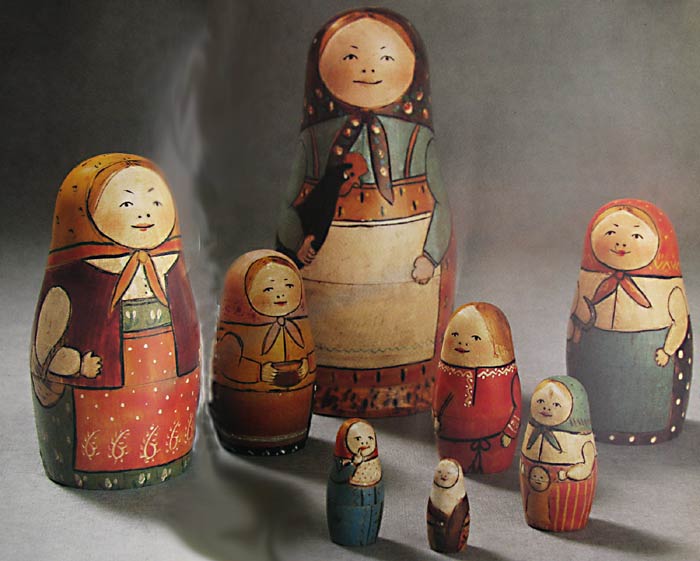

When people think of nesting dolls they immediately think of the Russian matryoshka doll. That association makes sense because for well over a century, Russian makers have introduced the world to their own matryoshka nesting dolls. Over time, the stacked wooden figures came to represent an idealized image of traditional Russian family life, especially the central role of the mother and the respect she receives within a large, multigenerational household.
Yet, despite their reputation as an ancient Russian tradition, a number of researchers argue that matryoshkas were less a sudden breakthrough than a Russian adaptation of earlier ideas. In other words, the concept was not created from nothing; it appears to have been refined from pre-existing nesting objects that circulated long before the first Russian sets were produced.
Does That Mean Nesting Dolls Didn’t Originate in Russia?
Many accounts say yes. While Russia popularized the form internationally, artifacts and records suggest the basic “one object inside another” idea dates back to the early centuries of the second millennium—hundreds of years before Russian matryoshkas appeared.
Around 1000 AD, craftspeople in China developed nested wooden containers that worked as both storage and decoration. A large box opened to reveal a similar but smaller one, which in turn contained another, continuing in a sequence of diminishing sizes. This practical design is often cited as an early precedent for the later shift from nesting boxes to nesting figures.

The nesting concept later reached Japan, where it was applied to small wooden representations of deities. Among the earliest examples cited are figures of the Shichi-Fukujin (the Seven Lucky Gods of Japanese mythology). One well-known piece depicts Fukurokuju, the deity associated with happiness and longevity, as a hollow figure that separates to reveal the other six gods inside. According to some retellings, a Russian visitor was intrigued by a doll of this type and carried it back home; the person most often named is Elizaveta Mamontova.
Russia’s First Matryoshka Sets
Elizaveta Mamontova was married to Savva Mamontov, a prominent Russian industrialist and entrepreneur known for supporting the arts. Motivated by an interest in nurturing and preserving Russian folk traditions, he established a workshop at Abramtsevo near Moscow. Often described as a children’s education or toy-making workshop, it set out to create dolls that reflected everyday Russian life and traditional culture.

Accounts differ on what, exactly, prompted the artists at Abramtsevo, especially Vasilii Zvyozdochkin and Sergei Malyutin, to produce what is widely regarded as the first matryoshka set. One version credits a Japanese nesting figure brought back by Elizaveta as the spark. Another argues the idea could have emerged locally, noting that detachable, layered objects (including certain Easter-egg forms) were already familiar in Russia. Because the surviving documentation is limited, historians do not agree on a single, definitive source of inspiration.
There are also recollections attributed to Zvyozdochkin suggesting he simply wanted to make a hollow figure with surprises concealed inside. Those memories do not clearly connect the project to either the Japanese Fukurokuju figures or earlier Russian precedents. However the idea took shape, Zvyozdochkin and Malyutin went on to produce an early set sometimes called the “Rooster Girl,” and they gave it the name “matryoshka.” It is often described as the first hand-carved wooden nesting-doll set made in Russia.
Why the Name “Matryoshka”?
“Matryoshka” is commonly interpreted as “little matron,” and it is linked to Russian women’s given names such as Matryona (also rendered as Matriosha in some contexts).
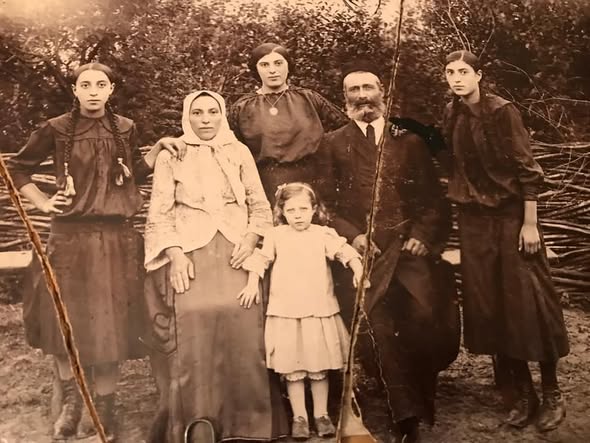
In the familiar interpretation, the largest figure in a matryoshka set stands for the mother of the household. Her rounded form is often read as a symbol of fertility and of the mother’s place at the center of family life. The smaller dolls hidden within can be understood as a visual metaphor for children carried and raised within the family, which is why the outer figure is typically female.
Large, close-knit families are frequently highlighted in descriptions of traditional Russian culture. In that model, family life extends beyond parents and children to include relatives across generations, grandparents, aunts and uncles, nieces and nephews, in-laws, and grandchildren, often imagined as sharing a common home and daily routines.
Descriptions of the earliest matryoshka set commonly note eight wooden figures that separate and fit one inside the next. The outermost doll portrays a woman holding a black rooster, hence the nickname “Rooster Girl.” Inside are seven smaller characters. Sources often describe the set as presenting nine character images in total, with most identified as female and one identified as male; two figures (a child pictured as if being carried by an older sibling, and a swaddled infant) are not consistently identified by gender in the accounts. Several dolls are shown holding objects, including the rooster, a scythe, a bowl said to contain porridge, and a broom, and the figures are painted in traditional Russian peasant clothing.

How the Matryoshka Nesting Dolls Gained Worldwide Popularity
Once again, Elizaveta Mamontova is thought to have played a key part in the matryoshka dolls’ popularity. Many historians believe that she was the one to bring them to the Exposition Universelle, a world fair held in Paris in the year 1900. The toy earned a bronze medal on the fair. Not long after, the concept gained popularity in its local land and was being created all over the country, causing a mass production of the dolls in Russia. Within a short amount of time, tourists would acquire the matryoshka nesting dolls and bring it with them to their homelands, gaining yet more exposure.
Matryoshka dolls are still being continuously made, with the majority produced in Russia. Traditional designs are still being followed, but over time the designs and patterns have evolved. Nesting dolls created in the present time can be designed with cartoon characters, political personalities, celebrities, nature, and animals, even customized to someone’s own family.
Either traditional or modern, the constant production of the Russian nesting dolls indicate that the toys are still being bought and enjoyed all around the world, exhibiting the once tranquil and simple lifestyle the early Russians once had, and the significance of a mother in a simple family.

Leave a Comment or Ask a Question