
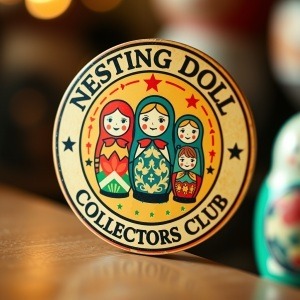
Vintage Nesting Dolls from Russia / USSR




About Semenov Dolls…
Semenov nesting dolls are the most iconic and globally recognized style of Russian nesting dolls. These traditional matryoshka dolls recognized by their vibrant yellow and red floral designs, often featuring a large, stylized rose on the apron. The distinctive “fingerprint” swirling is created by a stamping technique, where artists use a rolled-up piece of fabric or felt dipped in ink or aniline dye. These dolls originated in 1929 with the establishment of a woodworking cooperative in the town of Semenov. This town became a major center for matryoshka production, which blossomed over the following decades to become a distinct and globally recognized style.
Semenov nesting dolls are the most iconic and globally recognized style of Russian nesting dolls. These traditional matryoshka dolls recognized by their vibrant yellow and red floral designs, often featuring a large, stylized rose on the apron. The distinctive “fingerprint” swirling is created by a stamping technique, where artists use a rolled-up piece of fabric or felt dipped in ink or aniline dye. These dolls originated in 1929 with the establishment of a woodworking cooperative in the town of Semenov. This town became a major center for matryoshka production, which blossomed over the following decades to become a distinct and globally recognized style.


About Polkhov Maidan dolls…
Polkhov Maidan nesting dolls are uniquely recognized for their vibrant, “hot” colors (magenta, red, yellow, green), bold floral designs featuring a large, central rosehip (dog-rose) on the apron, and a distinct peasant style designed outlining with black ink. Their form is characterized by a cylindrical shape with higher shoulders and flatter, straighter sides compared to other styles. Polkhovsky Maidan matryoshka production began in the 1920s–1930s, heavily focusing on the “kustar” (cottage industry) style, with production flourishing from the 1960s through the 1990s.


About Zagorsk dolls…
Zagorsk (Sergiev Posad) nesting dolls are unique for their historical status as the birthplace of the traditional Russian matryoshka, featuring a distinct, rustic, and often heavily varnished design. They are characterized by a slightly disproportionate, sturdy shape, typically featuring thick, earthy gouache paint, prominent floral pattern, often with red, yellow, and blue colors, and expressive, oval faces. These dolls commonly have one arm at their side and the other arm bent at the elbow, often holding a basket, animal, or other small object.


About Kirov dolls.
Kirov (or Vyatka) nesting dolls are characterized by a distinct, slender “northern style” featuring rounded shapes, large faces, and long eyelashes, often decorated with soft floral patterns. Originating from the Kirov region around 1924, these traditional dolls frequently use red, yellow, and green colors. Some styles of dolls are decoration with rye straw, which gives them a distinct, golden, and textured appearance.


About Kalinin dolls…
The Kalinin (Tver) style of Russian nesting dolls is defined by a unique combination of wood-burning (pyrography) and thickly applied bright paints. Unlike the standard floral-focused dolls from other regions, Kalinin dolls, named after the city of Tver during the Soviet era, often feature a more rustic, handmade feel with distinct structural grooves.


About Brest dolls…
“Brest” style nesting dolls, come from the Brest Souvenir Factory (Brestskaya Fabrika Suvenirov) in Belarus. Belarus mean “white Russia” and was once part of the Soviet Union, but the region is its own country. This distinct has been producing a very wide variety of since 1953. These dolls, which gained popularity during the Soviet era, are celebrated for their hand-painted, authentic folk designs, fairy tales, professions, and animals.


About Mordva dolls…
Mordva (Mordovian) nesting dolls, often produced during the USSR era in the southeast region of Moscow, feature a distinct folk-art style characterized by vibrant, heavily embroidered red and yellow traditional dresses. Many styles have a flat top. These vintage wooden matryoshka dolls typically display intense floral patterns and dark-haired female figures with pronounced black outlines.


About Moldavia dolls…
Moldavia is located East of Rumania and South of the Ukraine. This area produced a few styles of dolls that are much different from one another. AP. Some Tiraspol dolls are very similar to Semenov dolls but often are painted with orange instead of red. AQ. Are some dolls that were sold as Moldavian, but another collector thinks that they are Yoscar Ola.


About Yoscar Ola dolls…
Yoshkar-Ola style nesting dolls, originating from the capital of the Mari El Republic, are known for their distinct folk aesthetic that blends traditional Russian craftsmanship with local Mari cultural motifs. Unlike more common floral-heavy styles, these dolls often emphasize regional costumes and specific geometric patterns.


About Ufa – Druzba dolls…
Druzba is not a region but means “Friendship” in Russian. Labels on some of these nesting dolls indicate they come from Ufa (Republic of Bashkortostan). These particular dolls are very rare and expensive.


Bogorodsk style nesting dolls, originating from the historic woodcarving center in the Nizhny Novgorod province (also the location of Polkhov Maidan). They are unique for their deeply rustic, unpainted or minimally painted aesthetic that emphasizes raw wood. Often featuring wood-burned churches or flowers and gold leaf on a natural surface doll. This city is know for carved wooden sculptures and toys – often bears or animals on a paddle that work with tools or otherwise move


About Ukraine dolls…
This Slavic country is located southwest of Russia. Dolls from this region are primarily painted in earth tones. Two sets have unusual shapes, the bullet maiden (shaped like a bullet) and the conical maiden (shaped like an egg). These dolls have both geometric designs and great detail.


About Kazakhstan dolls.
Kazakhstan is a country located between Russia and China and aside from Russia was the second largest republic in the former Soviet Union. It is a land rich in history and was the home of Attila the Hun, the Mongols, and later Genghis Kahn. It is the land of camels and the Silk Road.
Albums | Next Album B »
Leave a Comment or Ask a Question